
A TPO roof lasts 15 to 30 years. That’s a twice-as-long spread, and where your building lands in it has almost nothing to do with luck. It comes down to four things: membrane thickness, seam welds, drainage, and whether anybody looks at the roof between leaks.
Here’s what each of those does to the number, and how to tell which end of the range your roof is headed for.
Quick answer
Expect 15–30 years from TPO. A 60-mil membrane — the industry standard — reliably reaches 20–30 years when properly installed and maintained. Independent studies cited by the Roofing Industry Alliance suggest 80-mil systems can reach 35–40 years under optimal conditions. Thin membranes, cold-weather seam welds, ponding water, and unmanaged foot traffic are what pull a roof toward 15.
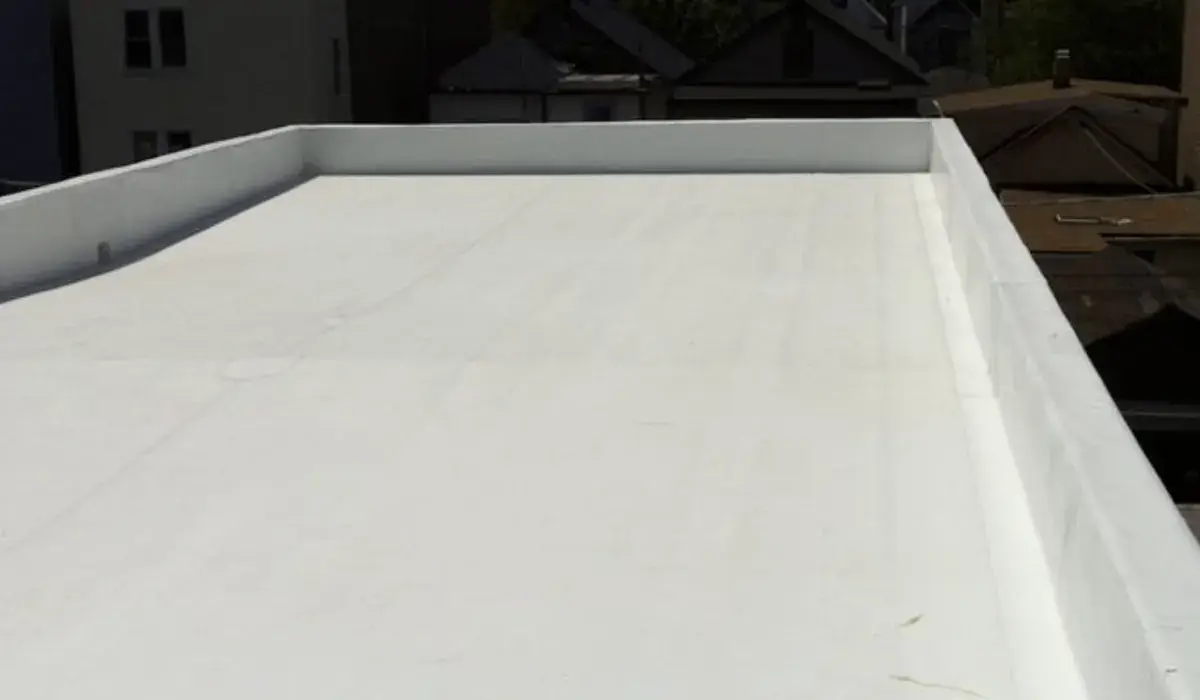
Why the range is so wide
Asphalt shingles fail fairly predictably — the material wears out. TPO usually doesn’t fail that way. A TPO roof that dies at 15 years generally didn’t wear out; something on it opened up.
That’s the useful mental model for a single-ply roof: it’s a continuous waterproof membrane, and its life is determined by the integrity of its weakest joint. The field of the sheet is rarely the problem. The seams, the flashings at penetrations, the perimeter terminations, and the low spots where water sits — those are the problem.
A single-ply roof doesn't wear out so much as it opens up. Its lifespan is the lifespan of its weakest seam.
Membrane thickness: 45, 60, or 80 mil
TPO comes in three common thicknesses, and the spec sheet number is one of the few lifespan variables you get to choose upfront.
Thickness
Expected service life
Where it fits
45 mil
Low end of the 15–30 range
Budget spec; least tolerance for traffic and hail
60 mil
20–30 years
The industry standard and most-installed thickness
80 mil
25–30 years, and 35–40 under optimal conditions
Heavy foot traffic, rooftop equipment, long-term ownership
External 2026 industry data; the 35–40 year figure for 80-mil reflects independent studies cited by the Roofing Industry Alliance under optimal conditions — not a guarantee for any specific building.
Thicker membrane resists thermal movement, punctures, and long-term UV better than thin membrane under identical conditions. If your roof gets serviced regularly — HVAC techs, grease-trap access, seasonal equipment work — the upcharge from 60 to 80 mil usually pays for itself, because puncture resistance is exactly what you’re buying.
The five factors that actually decide it
- Installation quality. The biggest single variable, and the one that’s invisible from the ground. TPO seams are heat-welded; a weld that’s too cool doesn’t fuse and a weld that’s too hot burns the sheet. Both look fine on day one.
- Drainage. Standing water shortens membrane life and finds every marginal seam. Drains, scuppers, and slope matter as much as the sheet.
- Foot traffic. Every service call is wear. Unprotected walkways around equipment are where punctures cluster.
- Penetrations and flashings. Curbs, pipes, drains, and edge metal are where the water gets in. The field of the membrane almost never leaks on its own.
- Maintenance. A roof that’s inspected twice a year and cleared of debris stays in the 20–30 band. A roof nobody visits until the ceiling stains does not.

Seam welds — the number one failure point
If you take one thing from this page: on a single-ply roof, the seams are the roof.
Heat-welded TPO seams should be probed after welding to confirm fusion — a hooked probe run along the seam edge finds the spots that didn’t take. Skipping that step is the most common corner cut in the trade, and it’s undetectable until year three when water starts tracking along a lap.
Cold weather makes it harder. Welding TPO in a Chicago-area November is entirely doable, but it takes adjusted welder settings, more frequent test welds, and a crew that checks its work as conditions change through the day. That’s a labor and attention issue, not a material issue — and it’s a fair question to ask any contractor bidding a late-season flat roof.
Same principle at the penetrations. Pipe boots, curb flashings, scupper boxes, and collector boxes are where a flat roof lives or dies, and generic parts stretched to fit a non-standard curb are a leak with a delay on it. We fabricate our own sheet metal details in-house — pipe flashings, collector boxes, scuppers, and edge metal formed to the actual opening rather than approximated with off-the-shelf pieces. No generic parts, no shortcuts.
Ponding water is a lifespan problem, not a cosmetic one
Flat roofs aren’t flat — they’re low-slope, and they’re supposed to drain. When they don’t, you get ponding, and ponding does three things:
- Accelerates membrane aging where water sits for days at a time.
- Loads the structure. Water is heavy, and a low spot collects more of it every time it deepens.
- Finds marginal seams. A lap that would never leak under runoff will leak under a week of standing water.
Causes are usually blocked drains and scuppers, crushed or saturated insulation creating a dish, deck deflection, or a slope that was never right. The fix depends on which — which is why “we’ll add a drain” isn’t an answer until somebody has figured out why the water is sitting there.

How to get the high end of the range
Nothing exotic here. The buildings that get 30 years do the same handful of things:
- Inspect twice a year. The NRCA recommends inspecting roof systems at least twice per year — preferably spring and fall — plus after any major weather event. That cadence catches seams and flashings while they’re still a caulk-gun problem.
- Keep drains and scuppers clear. Cheapest lifespan extension available.
- Install walk pads to and around every piece of rooftop equipment.
- Control who goes up there. Most punctures are made by trades that don’t work on roofs.
- Document everything. Most manufacturer warranties carry maintenance requirements, and an undocumented roof is a denied claim waiting to happen.
We put the full version in our commercial roof maintenance checklist — the section-by-section walkthrough for what to actually look at.
Not sure how much life your TPO roof has left?
We’ll probe the seams, check the drainage, and tell you straight whether it needs repairs, a coating, or replacement.
When a TPO roof is genuinely done
Repairs stop being the right answer when the membrane itself is spent. The signs:
- Crazing and chalking across the field — the surface has lost its UV package.
- Brittleness. Membrane that cracks rather than flexes won’t hold a patch.
- Seams separating in multiple locations, not just one lap.
- Wet insulation — a core cut or infrared scan shows saturation. Once insulation is wet, patching the top doesn’t dry it out, and the R-value is gone.
- Leak whack-a-mole. When you’re chasing a new leak every storm, you’re paying for a replacement in installments.
Between repair and replacement there’s a third option worth asking about: a roof coating or membrane restoration, which can add years when the substrate is dry and the seams are sound. It’s not a fix for a wet roof, and any contractor who offers it without checking for saturated insulation first is selling you a lid on a wet system. We find the root cause — no guesswork. A roof inspection with moisture testing is what settles it.
The bottom line
Plan on 20–30 years from a properly installed 60-mil TPO roof, more from 80-mil, less from a thin membrane on a building nobody inspects. Specify thickness deliberately, insist on probed seams, keep the drains clear, and get on it twice a year.
Black Square has installed and serviced flat roofing — TPO, PVC, EPDM, and modified bitumen — and commercial roofing across Chicagoland since 2007, from Schaumburg and Palatine to Wheaton and Downers Grove. We fabricate our own flashing details in-house, and Mike Bartkovjaks is on every project. Not a storm chaser. Not a franchise.
Frequently asked questions
How long does a TPO roof last?
A TPO roof lasts 15 to 30 years. A 60-mil membrane — the industry standard thickness — reliably reaches 20–30 years when properly installed and maintained, and independent studies cited by the Roofing Industry Alliance suggest 80-mil systems can reach 35–40 years under optimal conditions. Thin membrane, poor seam welds, ponding water, and unmanaged foot traffic pull a roof toward the low end.
Is 60 mil or 80 mil TPO better?
What is the most common cause of TPO roof failure?
How often should a TPO roof be inspected?
At least twice a year. The NRCA recommends inspecting roof systems twice annually, preferably in spring and fall, plus after any major weather event. Buildings with heavy rooftop equipment, frequent trade access, or membranes over 15 years old benefit from more frequent checks. Most manufacturer warranties also carry documented maintenance requirements.
Can a TPO roof be coated instead of replaced?
Sometimes. A coating or membrane restoration can add years when the insulation underneath is dry and the seams are sound. It’s not a solution for a wet roof — once insulation is saturated, coating over it traps the moisture and the lost R-value doesn’t come back. Any coating proposal should follow moisture testing, such as core cuts or an infrared scan, not precede it.