
A bay window roof is one of the smallest surfaces on your house and one of the most likely to leak. It’s low-slope, it has four or five direction changes in a few feet, and it dies into a wall at the top — three conditions shingles handle badly. Copper, flat-locked and soldered, is the right answer, and it can outlast the window it’s protecting.
Here’s what the system actually is, how long it lasts, what drives the cost, and the fabrication details that decide whether you get 15 years or a hundred.
Quick answer
A copper bay window roof uses flat-lock (flat-seam) copper panels with soldered seams — the standard approach for low-slope and curved bay roofs. Properly installed copper lasts 100+ years. Industry per-square-foot ranges run roughly $11–$21 for copper shingles and $28–$35 for standing seam and flat-seam copper sheet, though small areas price higher per square foot than a full roof.
Why bay windows get copper — and why shingles fail there
Asphalt shingles need slope. They shed water; they don’t hold it back. A bay window roof usually sits at a shallow pitch, which means water moves slowly across it and sits in the seams.
Then there’s the geometry. A typical bay roof has two hips, two or three facets, a wall termination at the back, and often a return into siding or brick. That’s six or seven transitions crammed into 25 square feet. Every one is a potential leak, and every one has to be flashed — not caulked.
Copper solves both problems at once. Soldered seams make the surface continuous instead of overlapping, so slope stops mattering. And because copper is formed on site or in the shop, the panels can be cut to the exact facets of your bay instead of approximated.
Most contractors treat a bay window roof as a shingle problem with extra caulk. It's a sheet metal problem — and it should be solved with sheet metal.
Flat-lock vs. standing seam on a bay window
Two copper systems come up for bay windows, and they aren’t interchangeable.
System
Best for
How it seals
Flat-lock (flat-seam)
Low-slope, curved, and multi-faceted bay roofs — the usual choice
Interlocking pans with soldered seams; smooth continuous surface
Standing seam
Steeper bays, modern architecture, taller runs
Raised vertical seams with concealed clips; strong vertical lines
Copper shingles
Small accents, dormer overhangs, decorative faces
Overlapping pieces — needs adequate slope
For most Chicago-area bay windows, flat-lock is the correct call. The soldering is the whole point: a soldered flat-lock seam is a watertight metallurgical joint, not a lap held shut by sealant that has a 10-year life of its own. If a contractor proposes flat-lock copper and doesn’t mention soldering, that’s the question to ask.

How long a copper bay window roof lasts
Copper is a generational material. Installed correctly, expect 100+ years — longer than the asphalt roof above it, longer than the windows underneath it, and longer than most of the house’s other components.
Material
Typical lifespan
Copper
100+ years
Slate
75–100+ years
Clay / concrete tile
50–100 years
Standing seam steel / aluminum
40–70 years
Architectural asphalt shingles
20–30 years
Industry lifespan ranges (2025–2026), consistent with our materials guide. Real-world life depends on fabrication quality, fastener metallurgy, and flashing detail.
The honest caveat: copper doesn’t fail, but bad details do. When a copper bay roof leaks at year 12, it’s almost never the copper — it’s an unsoldered seam, a steel nail that rusted out, or a wall flashing that was surface-caulked instead of counterflashed into the masonry. We compare copper against the other long-life options in our best roofing materials guide.
What the patina does — and how long it takes
New copper is bright penny. It darkens to bronze and then chocolate brown over the first few years, and eventually turns the blue-green patina people picture. That green layer isn’t decay — it’s a protective oxide skin that shields the metal underneath from further corrosion.
Timing depends on the environment. In industrial and coastal areas, the green patina can develop in 10 to 15 years; in dry, rural settings it takes considerably longer. Chicago’s northwest suburbs and North Shore sit between those extremes, so plan on years of the brown stage before green begins to show. If you want the aged look immediately, chemical patination solutions can age copper in a day or two — worth deciding before fabrication, not after.
Two honest notes most contractors skip:
- Runoff can stain what’s below. Water running off new copper can streak light-colored siding, limestone, or painted trim beneath the bay. It’s manageable with the right drip detail and gutter placement, but it should be planned for.
- Facets weather unevenly. A sheltered face under an overhang will patina slower than one taking full sun and rain. That’s normal, not a defect.

What a copper bay window roof costs
Copper is the most expensive common roofing metal, and there’s no honest way around that. Published 2026 industry ranges land roughly here, installed:
Copper option
Industry range (installed)
Notes
Copper shingles
$11–$21 / sq ft
Least expensive; needs slope
Standing seam copper
$28–$31 / sq ft
Concealed fasteners; steeper bays
Flat-seam copper sheet
≈ $35 / sq ft
Soldered seams; the low-slope solution
External 2026 industry cost ranges — not a Black Square quote. Your number depends on the bay’s size, facets, wall termination, and metal weight (16 oz is the residential standard).
Two things homeowners are usually surprised by, so we’d rather say them upfront:
- Small areas cost more per square foot. A 30-square-foot bay roof still needs a shop, a brake, staging, a soldering setup, and a day of skilled labor. Per-square-foot math from a full-roof project doesn’t apply to it.
- The flashing is a real line item. The apron, counterflashing, and hip details are where the labor sits. Cheap bids usually got cheap by leaving those out.
Ask for it itemized. If a bid is one lump sum with no mention of soldered seams, fastener type, or wall counterflashing, you can’t compare it to anything.
The five details that decide whether it lasts
This is the part that separates a copper bay roof that’s still fine in 2120 from one that stains the plaster in 2038.
- Soldered seams, not sealed seams. On low slope, the seam has to be soldered. Sealant is a maintenance item pretending to be a roof.
- Copper and stainless fasteners only. Copper in contact with aluminum or galvanized steel sets up galvanic corrosion — the lesser metal sacrifices itself and you get a leak at a fastener. That means copper nails, copper cleats, stainless where required, and care where the bay roof meets aluminum gutters or downspouts.
- Counterflashing into the wall, not onto it. Where the bay roof dies into brick or siding, the flashing has to be let into a reglet or tucked under the siding course — surface-caulked terminations are the single most common failure point on bay roofs.
- Cleats, not face nails. Copper moves with temperature. Concealed cleats let the pans expand and contract; nails driven through the field fight that movement until something tears.
- Custom-formed pans. A bay’s angles are rarely the angles on a catalog part. Pans, hips, and corners should be cut and formed to the measured facets of your bay.
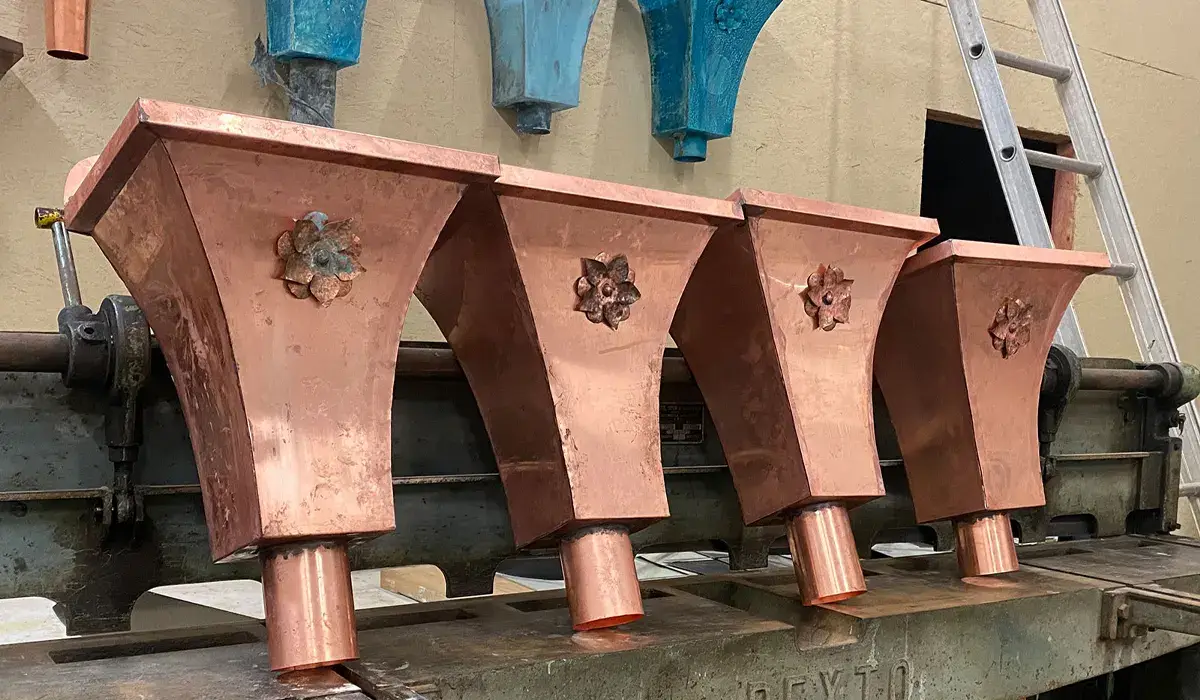
That last one is why we fabricate our own. Black Square runs an in-house sheet metal shop — we form the pans, hips, drip edge, and counterflashing for each bay window ourselves in steel, aluminum, copper, or zinc rather than adapting off-the-shelf parts to fit. Made for your home, not off-the-shelf. Mike Bartkovjaks oversees the metalwork personally.
Bay window leaking, or planning copper?
We’ll measure the bay, tell you which system it actually needs, and give you an itemized estimate — no pressure, no upsells.
The bottom line
A bay window roof is a small job that behaves like a hard one. Copper handles the low slope and the direction changes that shingles can’t, and it’s a once-in-the-life-of-the-house decision — but only if the seams are soldered, the fasteners are compatible, and the wall termination is done properly.
We’ve been fabricating and installing copper across Arlington Heights and the North Shore since 2007 — copper roofing and custom metal fabrication are the work we’re known for, from bay windows and dormers to full copper roofs in Winnetka and the surrounding villages. Not a storm chaser. Not a franchise. Owner on every project.
Frequently asked questions
How long does a copper bay window roof last?
Properly fabricated and installed copper lasts 100+ years — longer than the asphalt roof above it or the window beneath it. When a copper bay roof does leak early, the cause is almost always a detail rather than the metal: an unsoldered seam, an incompatible fastener that corroded, or wall flashing that was surface-caulked instead of counterflashed into the masonry.
How much does a copper bay window roof cost?
Published 2026 industry ranges run about $11–$21 per square foot for copper shingles, $28–$31 for standing seam, and around $35 for flat-seam copper sheet, installed. Bay windows price higher per square foot than a full roof because a small area still requires shop fabrication, staging, soldering setup, and a day of skilled labor. Ask for an itemized estimate rather than a per-square-foot figure.
Should a bay window use flat-lock or standing seam copper?
Flat-lock (flat-seam) copper is usually correct for bay windows because their pitch is shallow and their shape is faceted or curved — the soldered seams make the surface watertight regardless of slope. Standing seam suits steeper bays and more modern architecture. The right choice depends on measured pitch and geometry, so it shouldn’t be decided from a photo.
How long until a copper roof turns green?
Copper darkens to bronze and then brown within the first few years. The blue-green patina develops in roughly 10–15 years in industrial and coastal environments and takes longer in drier inland areas, so Chicago-area homeowners should expect years of the brown stage first. Chemical patination can produce the aged look in a day or two if it’s decided before fabrication.
Can copper be installed next to aluminum gutters?
It can, but it has to be detailed deliberately. Copper in direct contact with aluminum or galvanized steel causes galvanic corrosion, where the weaker metal deteriorates and eventually leaks at the connection. That means copper or stainless fasteners throughout and a separation or compatible transition wherever the copper meets a dissimilar-metal gutter or downspout.
Cost ranges and patina timelines reflect 2026 published industry data from independent sources including HomeGuide, This Old House, and EcoWatch, plus flat-seam bay window method references from Fine Homebuilding and the Copper Development Association. Ranges are general estimates for planning — your project’s scope and price depend on an on-site assessment.